Years before police say Fairfax killed his estranged wife, women accused him of violence. The party talked about accountability, then looked away.
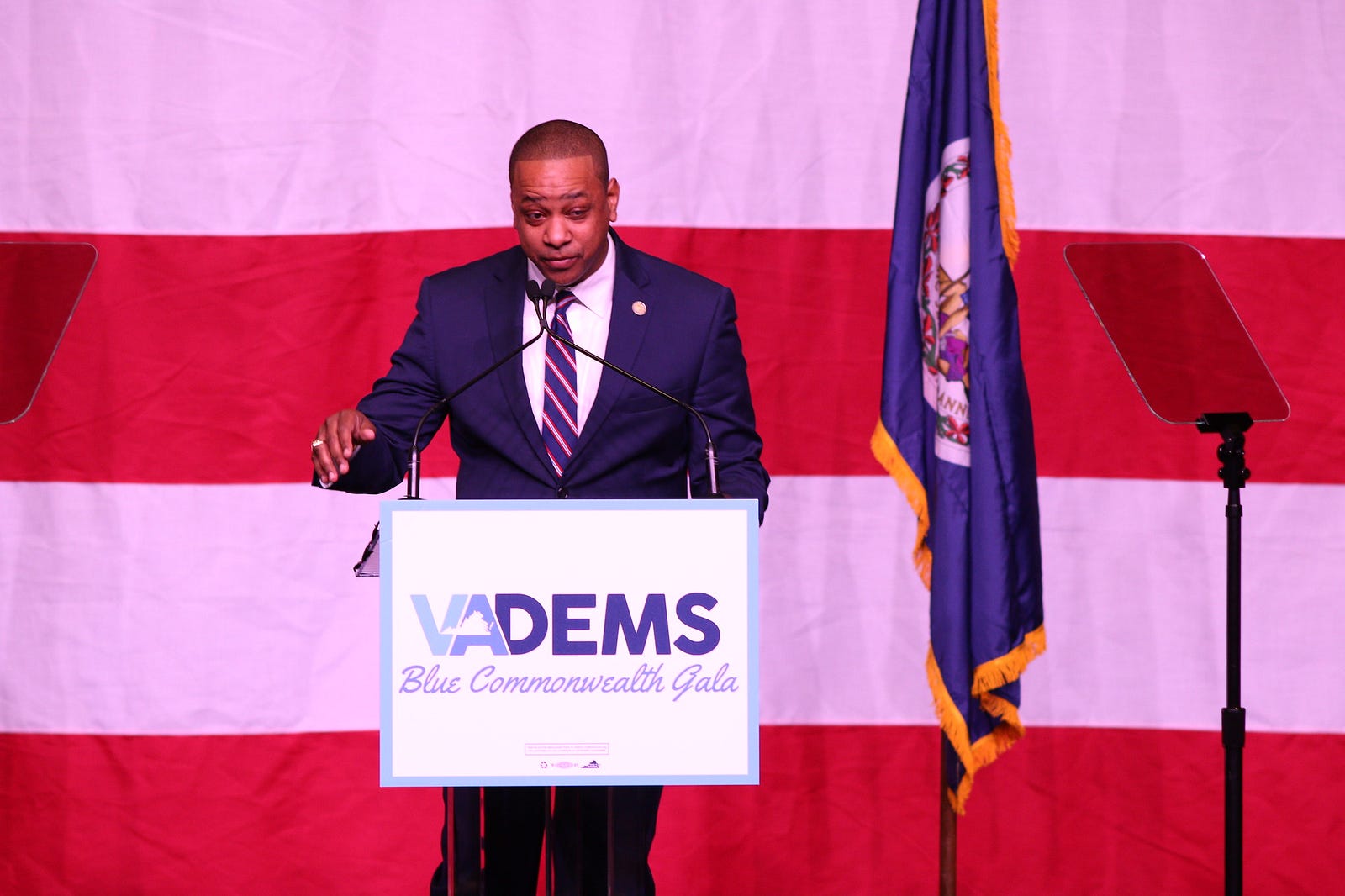
On Thursday, April 16, 2026, police said former Virginia Lieutenant Governor Justin Fairfax fatally shot his estranged wife, Dr. Cerina Fairfax, and then killed himself in what authorities described as an apparent murder-suicide. Their teenage children were in the home; one of them was forced to the dreadful expedient of calling 911.
Police said the couple were in the middle of a bitter divorce, still living under the same roof, and that an earlier January accusation by Justin Fairfax that his wife had assaulted him was disproved by home-camera footage.
That is where this tragic story ends.
But it is not where the warning signs began.
Warning signs were flashing red in 2019, when two women, Vanessa Tyson and Meredith Watson, publicly accused Justin Fairfax of sexual assault. He denied both allegations and was never formally charged. But perhaps that was because Virginia’s political system never created a serious, credible, bipartisan fact-finding process worthy of allegations this grave.
Instead, it drifted into a fog of excuses, jurisdictional dodges, and partisan convenience.
After the Virginia legislature failed to act, Fairfax’s accusers expressed disappointment. Perhaps if Fairfax had faced serious consequences after they came forward, the women may have felt more empowered to take their accusations to the next level. After prominent Democrats shielded Fairfax, why would they bother?
At the height of the scandal, Democrats said the right things — in public. Many called on Fairfax to resign.
Reuters reported on February 11, 2019, that Virginia Democrats were pressuring him to step down even as they stopped short of impeachment. But when that resignation did not happen, the system froze. A threatened impeachment effort fizzled. House Democrats said they wanted law enforcement to handle it “outside the political arena.” And that phrase, which sounded responsible at the time, became a way of ensuring that no arena would handle it.
The women who accused Fairfax saw exactly what was happening. Meredith Watson publicly said she was willing to testify under oath in public. Tyson’s lawyers said it was astonishing that the General Assembly appeared ready to end its session without addressing the allegations in any meaningful way. AP reported that both accusers criticized the legislature’s inaction.
Later, when Republicans renewed calls for a public hearing, most House Democrats were opposed, dismissing it as political theater.
Oh, was it?
Maybe some of them believed that. Maybe some were simply relieved to have a reason to look away. Either way, the effect was the same. No bipartisan hearing. No real legislative probe. No reckoning.
No consequences for violence against women.
And what, exactly, did “let the legal system work” produce? Very little.
Tyson did move toward meeting with Boston prosecutors. Fairfax later asked prosecutors in Massachusetts and North Carolina to investigate both allegations. But ABC reported that prosecutors did not publicly respond to that request, and AP later reported that the investigations Fairfax wanted were “never opened as far as he knows.” No criminal charges were filed. No trial happened. No public declination laid out the facts and the reasoning. The legal system did not resolve the matter. It merely failed to do so, while politicians used that failure as cover.
It is not enough to say this was “institutional paralysis,” as though nobody could help it. Doing nothing was a choice. When powerful people decide not to build a forum, not to compel testimony, not to investigate seriously, and not to force a public accounting, that is not neutrality. That is protection.
Not necessarily because every Democrat believed Justin Fairfax was innocent. More likely because too many of them decided the risk, inconvenience, and political mess of confronting the allegations were greater than the moral cost of evading them.
Now, it appears they were dreadfully wrong. Justin Fairfax was a danger to women. Virginia Democrats should have taken that danger seriously.
We cannot say with certainty that if Virginia Democrats had acted differently in 2019, Cerina Fairfax would still be alive today. But it is entirely fair to ask whether a man accused by two women of sexual violence, left in office without a meaningful inquiry and without real consequences, learned the oldest lesson in politics: that powerful systems often protect their own. And it is fair to say that the women who came forward were failed twice — first by the man they accused, and then by the institutions that would not truly hear them.
Justin Fairfax was once treated as a rising Democratic star, a man who might even become governor during Virginia’s 2019 political upheaval.
Instead, he finished his term under a cloud, attempted a political comeback in 2021, and lost badly. But political decline is not the same thing as accountability. Accountability would have meant a process.
Accountability would have meant the women were heard in a forum designed to discover facts rather than avoid them. Accountability would have meant Virginia’s leaders choosing courage over calculation. They did not. And now a woman is dead, two children are traumatized, and Democrats in Virginia are left staring at a terrible question they should have confronted years ago: what happens when warning signs about violence against women are treated as an inconvenience instead of an emergency?
Domestic violence and violence against women is not rare, fringe behavior; it is one of the most common and enduring forms of violence in modern society.
Globally, the World Health Organization says about 1 in 3 women will experience physical and/or sexual violence in their lifetime, most often at the hands of an intimate partner.
In the United States, the CDC says more than 1 in 3 women have experienced contact sexual violence, physical violence, and/or stalking by an intimate partner in their lifetime, and 5.2% of women experienced that abuse in just the previous 12 months.
The problem is so widespread that the National Domestic Violence Hotline says an average of 24 people per minute in the U.S. are victims of rape, physical violence, or stalking by an intimate partner. This is not a private matter tucked behind closed doors. It is a mass social failure, a public-safety crisis, and for far too many women, a deadly one.
The system failed Vanessa Tyson and Meredith Watson. They tried to warn us about Justin Fairfax. We should have listened.
(Contributing writer, Brooke Bell)
If you or someone you know is experiencing domestic violence, sexual violence, or fears for their safety, call the National Domestic Violence Hotline at 800–799-SAFE (7233) or the National Sexual Assault Hotline at 800–656-HOPE (4673) for free, confidential, 24/7 support.